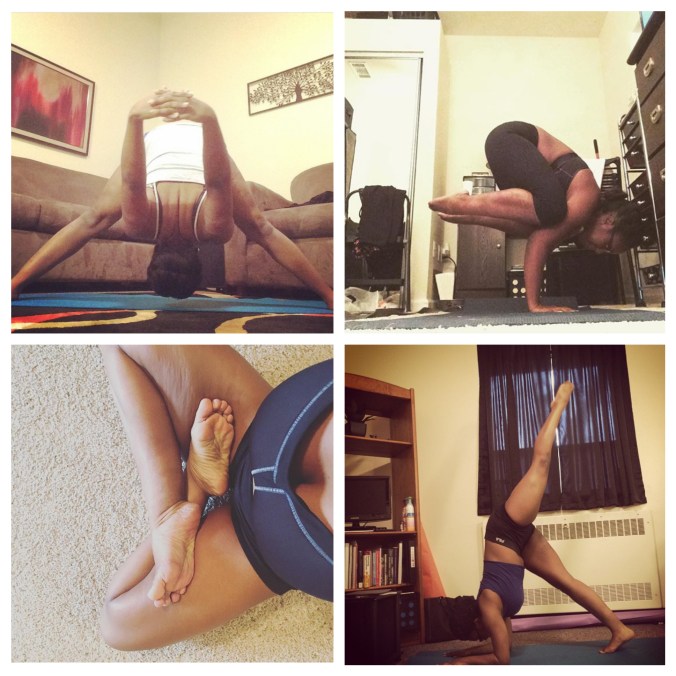
Let’s be honest, even if I had the money to go to yoga classes several times a week (I don’t), it doesn’t always fit into my schedule. But attempting to build a home yoga practice with no guidance can be extremely intimidating. I know from experience. Luckily, after two years of practicing at home I’ve picked up some helpful tips and tricks. So if you’re like me and want to bring your yoga practice home, keep reading!
1. Go to a yoga class (or two or three).
The best way to start a home yoga practice is to take a few classes first. Try a variety of instructors and yoga traditions (ashtanga, iyengar, vinyasa, etc.) to get a feel for what you like and don’t like.
While you’re there, pay attention to the instructor’s cues about proper form in key postures like downward-facing dog and chaturanga dandasana. You won’t be able to remember everything, but feeling comfortable in these foundational postures will significantly boost your confidence in your ability to practice at home by yourself.
Finally, notice that you never start class with the most challenging postures first. You always build up to them. If done right, your body will be able to do things at the end of class that weren’t remotely possible when you first unrolled your mat. Keep this in mind as you start your own practice. If you try to force your body into postures without properly warming up, you won’t be able to go as deep and you’ll risk injuring yourself.
2. Get your gear.
While you really don’t need anything but your body to practice yoga, who am I to deny someone the joy of shopping for new goodies? To get you started, consider picking up these basics:
- Yoga Mat – Any kind will do. You may slide more on cheaper ones, but you can combat that by keeping a towel nearby to dry your hands and feet.
- Blocks – Depending on your level of flexibility, blocks may be necessary to attempt some postures like Extended Side Angle Pose. Don’t have blocks? Large books will do just fine for most things.
- Straps – Straps can be helpful when working on flexibility in postures like Dancer’s Pose. Don’t have a strap? Use a belt instead!
*Tip: Wait to buy expensive clothes and gear until you’re established in your practice! Consider them a reward for practicing consistently. There’s nothing worse than dropping $200 on a new hobby and then moving on to something else two weeks later. Instead, wait to buy yourself that new mat until you’ve been practicing regularly for at least 3 months. 😉
3. Find online classes.
While it’s not essential to use online classes, for people like me who lack creativity when it comes to choreography and movement, online classes take a lot of the stress out of practicing at home.
There are tons of free classes on YouTube (try theses), but my favorites right now are: this paid plan on Cody App that focuses on building strength and this 30-day series designed to help you learn a different basic yoga posture each day (trust me, basic does not mean easy). If you’re interested in either, look out for sales. They’re pretty pricey, but I consider them a great investment since I have access to them forever and I no longer pay for in-person classes.

I like to mix and match different online classes to best suit my needs. Here’s a schedule I created recently which incorporates both of the paid plans above.
4. Push yourself, but listen to your body.
One of the greatest advantages of a home practice is you make the rules. But with this freedom comes its own set of challenges. You may find yourself wondering, am I doing enough? Am I doing too much? Based on my research and experience, here are some flexible guidelines that should help you get off to a good start:
- If your schedule allows, try to get on your mat at least 3-4 days per week.
- Incorporate at least one rest day each week.
- Not sure if you’re doing enough? Ask yourself, do I feel challenged? Have I reached my limit? Can I give it one more try? While you don’t need to push yourself to muscle failure every day to see progress in yoga, it’s important to challenge yourself. To quote one of my favorite yogis, Kino MacGregor, yoga begins at the point when you start to doubt yourself and the practice. Pushing through this is a part of getting stronger.
- Concerned you may be pushing too hard? Ask yourself, is my breathing shallow and uneven? Is my face scrunched up? Am I in pain? Have I sacrificed good form? Am I thinking negative thoughts towards myself? If the answer to any of these questions is yes, you may need to take a step back. And keep in mind, just because you were able to do something yesterday doesn’t mean you will necessarily be able to do it today. Listen to your body and accept what it can do at this moment.
Tips to Stay Inspired
Join the instagram yoga community! Surrounding yourself (virtually) with amazing men and women who have dedicated themselves to their practice will serve as an endless supply of inspiration and motivation. Check out some of my favorite hashtags to begin connecting: #yogainspiration #yogachallege #yogaeverydamnday #yogisofcolor #beginneryogi. Oh, and follow me at @sheglitterslikegold!
Join an instagram yoga challenge. IG yoga challenges are another great way to motivate yourself to practice each day. Not only do you get to interact with hundreds of other yoga enthusiasts, but you have a very real chance of winning some cool prizes (in fact, during my very first challenge I won a chakra bracelet)!
Drop by a class. If your home practice has become non-existent and you’re really struggling to get back on your mat, sometimes going to an in-person class can rekindle your motivation. While you’re at it, invite a friend so you’ll have more incentive to go!
Track your progress. There’s no better way to stay motivated than to see how much you’ve improved. Progress can be mental or physical, just make sure you keep track of it! Instagram is a great place for that too. 🙂
While starting (and maintaining) a home practice can be difficult, I’ve found it to be a crucial part of my yoga journey. Once I took ownership of my practice, yoga stopped being something I did and became a part of who I am and how I view the world. My biggest piece of advice: don’t give up! And if you do, forgive yourself and begin again. None of us is perfect, but with a little dedication I promise you can have the home practice you’ve always wanted!
 The Golden Life