A few weeks ago I wrote a blog post about a book I’d stumbled across and was excited to add to my reading list. Getting Things Done by management consultant and productivity expert David Allen, outlines a work-life management system developed around the premise that “your mind is for having ideas, not holding them.”
Allen works one-on-one with CEO’s and other high-ranking business professionals to help them organize their work and personal lives. Many of those top professionals swear by his methods, but I was curious how they would translate for little ol’ me.
First, a little more about the GTD system from David Allen himself:
“The methods I present here are all based on two key objectives: (1) capturing all the things that need to get done—now, later, someday, big, little, or in between—into a logical and trusted system outside of your head and off your mind; and (2) disciplining yourself to make front-end decisions about all of the “inputs” you let into your life so that you will always have a plan for “next actions” that you can implement or renegotiate at any moment.”
I finished reading the book last week and began the task of overhauling my organization system immediately. GTD consists of the following five steps:
1) Capture. Collect what has your attention. Use an in-basket, notepad, or voice recorder to capture 100% of everything that has your attention. Little, big, personal and professional—all your to-do’s, projects, things to handle or finish. – Getting Things Done
This was fun. The moment I started getting things out of my head, I felt lighter. Allen recommends using a physical in-basket for this exercise, but I was immediately put off by the thought of holding on to all that paper. It might make sense for those who have to deal with large amounts of paperwork as a part of their job, but for me a digital inbox was definitely the way to go.
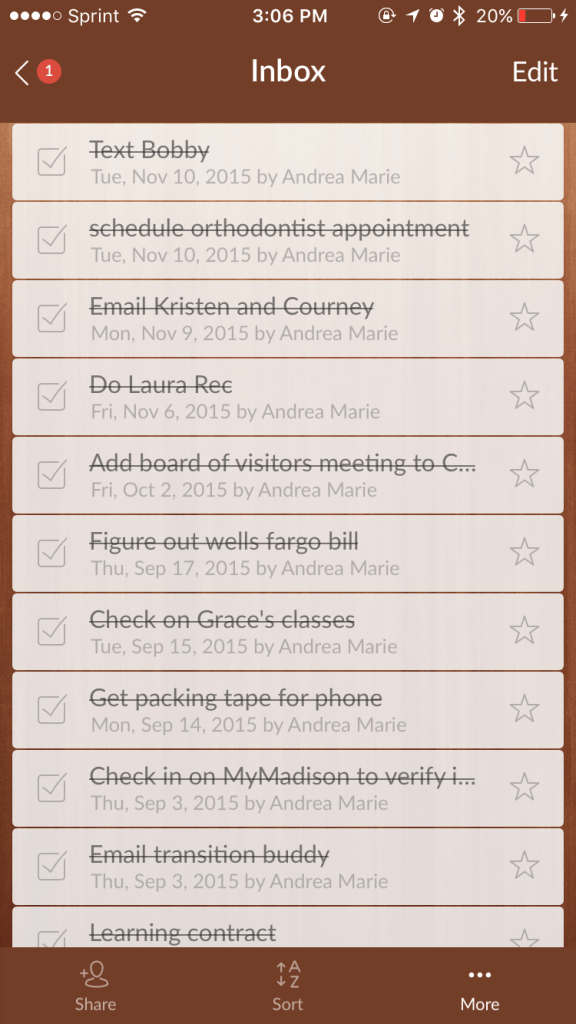
A screenshot of my digital inbox created using the Wunderlist app.
2) Clarify. Process what it means. Take everything that you capture and ask: Is it actionable? If no, then trash it, incubate it, or file it as a reference. If yes, decide the very next action required. If it will take less than two minutes, do it now. If not, delegate it if you can; or put it on a list to do when you can. – Getting Things Done
This step marks a huge departure from how I used to do things, but I welcome the change. Even though it’s only been a week, I can already tell making a habit of processing to-dos on the front end will be game changing. Some things I’ve noticed:
- Because I know every bullet in my inbox will have to be immediately assessed for its next action, I am more selective about what I allow into my inbox in the first place. That means making the (sometimes difficult) decision to trash projects before I’ve spent weeks thinking about them and feeling guilty about not having done them.
- Deciding on next actions immediately has gotten rid of a HUGE procrastination trigger. When there is no next action attached to a project, a cognitive gap is created. Every time you think about the project, there will be subconscious resistance to actually doing it because you can’t envision the first step. By expending the extra energy on the front end to determine what that step is, you’ll spend less time stressing about what you have to do and more time doing it.
- The two-minute rule is magical. It also sucks. You’d be amazed how many daunting things on your to-do list can be jump-started with a mere two-minute action. You’d also be amazed at how much resistance you can generate towards a task that will literally only take two minutes. But when you put it off, you’ll probably spend a lot more than two minutes thinking about it. Since implementing the two-minute rule, I’ve moved forward on several neglected projects and finished a handful of others. It’s one of those things I love to hate, but it won’t be going anywhere.
3) Organize. Put it where it belongs. Put action reminders on the right lists. For example create lists for the appropriate categories—calls to make, errands to run, emails to send, etc. – Getting Things Done
Allen’s tips for organizing your to-do’s are gold. The lists are half of the magic of his system. With my old to-do lists, I sorted tasks in terms of the context in which they were received (school tasks, work tasks, personal errands). What Allen suggests, however, is sorting tasks in terms of the context in which you will be getting them done. That means I have an “In the Car” list for all of my out-and-about errands, a “Meeting w/ Boss” list that contains business I need to bring up when I’m with my boss and a “Study Time” list for when I’m in the library doing school work. As a result, whenever I’m in one of those places/situations I don’t have to think. I just go straight to the list and know exactly what needs to be done. The best thing about this is I have fewer of those darnit-I-was-just-at-the-store moments where I had the perfect opportunity to complete a task but completely forgot about it.
4) Reflect. Review frequently. Look over your lists as often as necessary to determine what to do next. Do a weekly review to clean up, update your lists, and clear your mind. – Getting Things Done
The GTD system only works if you check your lists religiously. This is something I’m notorious for not doing and it has already resulted in a few missed opportunities to get things done. My hope is that in time, checking my lists will become like a reflex. But until then I’ll focus on keeping them up-to-date so I can trust that when I do review them, I’m seeing all of my options. This should definitely keep me occupied as I’m always finding new loose ends.
5) Engage. Simply do. Use your system to take appropriate actions with confidence. – Getting Things Done
Organization has always been a weakness for me. For a long time I considered it something intrinsic (“I’m not an organized person”), and although I often experienced negative consequences because of this, I felt powerless to change it. Getting Things Done has shifted my perspective. I feel like I’ve been given the tools to create a more productive, less stressed, overall happier version of myself. Only time will tell whether the Getting Things Done methodology will stick, but considering the benefits I’ve already experienced, I’d be crazy to go back to my traditional to-do list.
To hear my thoughts on the GTD system 2 years later, click here!
 The Golden Life