In less than six months, my life will change dramatically in two big ways.
LIFE CHANGE #1: Introducing Dr. Pope
First, on May 7th, 2020–after 23 YEARS of formal education–I will finally be done with school. I cannot express how ready I am to close this chapter of my life! *laugh cries*
If you didn’t know, I have been pursuing a Ph.D. in educational assessment and measurement for the last 3.5 years. If you have no idea what that is (or just want to know what I’ve been up to in school), check out this short video of me explaining it!
LIFE CHANGE #2: A Walk in the Woods
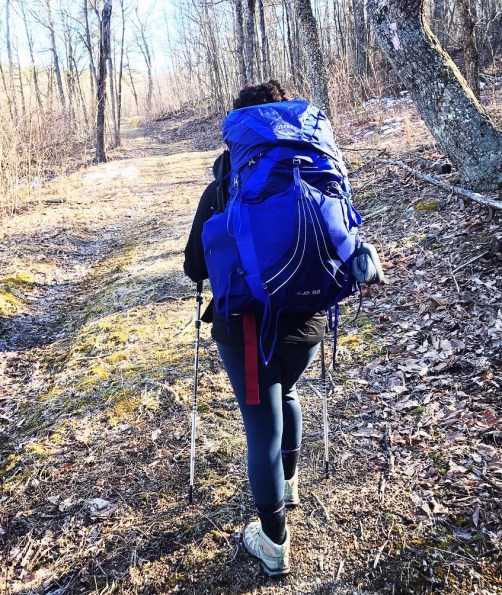
After graduation, I will embark on the adventure of a lifetime. More specifically, I will be solo-hiking the Appalachian Trail (AT), which stretches all the way from Georgia to Maine!
Since making the decision to hike the AT, I have gotten a lot of questions from family and friends. Below, I’ve attempted to answer some of the most frequently asked ones.
What is the Appalachian Trail?
The Appalachian Trial was completed in 1937 and stretches from Springer Mountain in northern Georgia to Mt. Katahdin in Maine. It is the longest hiking-only footpath in the world, at approximately 2,190 miles long. Over the course of those 2,190 miles, hikers walk through 14 states and experience over 460,000 feet in elevation gain/loss (the equivalent of hiking Mt. Everest, the tallest mountain in the world, 16 times).
How long will it take you to hike it?
The AT is typically completed in 5-6 months, with hikers averaging about 15-20 miles per day.
You’re going to be hiking by yourself?!?!?! Isn’t that dangerous?
It is common for AT thru-hikers start out alone, but few remain that way. Within a couple of weeks, many hikers find a “tramily” (trail family)—a small group of like-minded folk who naturally hike at the same pace and look out for each other. Even without a tramily, however, hiking the AT is not a lonely experience. Over three million people visit the AT each year, with upwards of 5000 people attempting thru-hikes yearly.
As for safety, I’m much more likely to be the victim of a crime while visiting a big city (or even just walking around tiny ol’ Harrisonburg) than I am on trail. But, of course, I will be taking a few reasonable precautions, such as carrying a small pocket knife and being sure to check in with family once per day.
But aren’t you afraid of bears/snakes/ticks???
Black bears are commonly found along the Appalachian Trail, but they generally do their best to steer clear of humans. In fact, many thru-hikers never see more than their backsides disappearing into the trees as they run away. Bear attacks are extremely rare and bear-related deaths are even rarer. Nonetheless, I have done extensive research on how to avoid bear encounters and what to do if I happen to come across one that doesn’t run away. The most important thing is to properly store all food/scented items (I’ll be carrying a bear-proof canister for that purpose).
In truth, I’m most concerned about ticks. Tick-borne illnesses can be brutal and hard to treat…and it only takes one small tick bite to transmit them. To minimize the risk, I will be sending all of my clothes to be treated with a long-lasting insect/tick repellant (permethrin). I will also be applying insect repellant (picaridin) daily and doing routine tick checks.
As for snakes, I’ll be sure to watch where I step and give them their space! But life-threatening snake bites are also extremely rare.
How are you going to survive for 6 months in the wilderness?
Generally speaking, every 4-7 days the Appalachian Trail runs through or near towns of varying sizes. In these towns, I will be able to shower, resupply, and even book a night in a hostel if I’m feeling fancy (i.e., not poor).
So, it’s almost like I’ll be doing a series of week-long backpacking trips. And I’ll carry on my back everything I need to survive those multi-day stretches outdoors (tent, sleeping bag/pad, clothes, rain gear, food/stove, water, first aid, and so on).
What have you done to prepare?
Aside from the dozens of hours I have put into researching gear and the trail, I have also completed a day-long course on how to read/use a map and compass and have completed over a dozen solo day hikes and one overnight backpacking trip. Before I leave next summer, I plan to complete at least ten more hikes and two more overnight trips.

Pictures from my 2019 hikes.
But Andrea, why would you want to spend six months roughing it in nature?
Several years ago, I read a book written by a clinical psychologist called The Defining Decade. In it, she talks about how to make the most of the “twentysomething” years and how to navigate many of the common struggles young adults face, such as picking a career path and dealing with imposter syndrome. One thing that really stuck with me from the book was the author’s reflection on how to build self-confidence. She writes:
A long run of easy successes creates a sort of fragile confidence, the kind that is shattered when the first failure comes along. Real confidence comes from mastery experiences, which are actual, lived moments of success, especially when things seem difficult.
In other words, confidence develops as a result of doing hard things and succeeding. It is not enough to succeed at the things that come naturally to you (in my case, school). To build a lasting, unshakeable self-confidence that can weather life’s failures and setbacks, you have to do the things that scare you. You have to challenge yourself again and again, and prove to yourself that you can rise to the occasion.
Undoubtedly, this hike will be an opportunity to disconnect, recharge, and recalibrate my priorities. But most importantly, it will be a chance for me to prove to myself that I can do hard things. Because if I can do this, I can do damn near anything.
How much does it cost to hike the AT?
You would think living in a tent would be cheap. But, as it turns out, thru-hikers actually spend about $700-1000 a month on trail (and that doesn’t even include the money required to pay bills at home)!
Some of the biggest expenses on trail are:
- Food
- Lodging (one hostel stay per week adds up)
- Transportation (although hitch-hiking is common, many hikers prefer to catch shuttles to and from nearby towns when possible)
- And gear replacements (did you know the average thru-hiker goes through 3-5 pairs of shoes?)
Lack of funds is one one the top reasons hikers fail to complete the trail, but I’m working hard to make sure that won’t be the case for me. I got a part-time job this year waiting tables at Olive Garden and so far, I’ve been able to save about $2000.
With that being said, if you would like to help me reach my $5000 savings goal, consider contributing to my GoFundMe as an early Christmas, birthday, or graduation gift. Your support means so much to me. ❤
Will you be documenting your time on trail?
Absolutely–for myself first and foremost, but also for my family and friends. My plan right now is to post to this blog site at least twice a month. I will also use instagram to share more frequent updates. If you want to be put on an email list to receive a head’s up when I make new blog posts about the trail, just let me know.
Welp, that’s about it! 2020 is going to be an absolutely amazing year. Thanks for taking the time to read about it, and I can’t wait to share my adventures with you.
With Love,
Andrea



 The Golden Life